Introduction
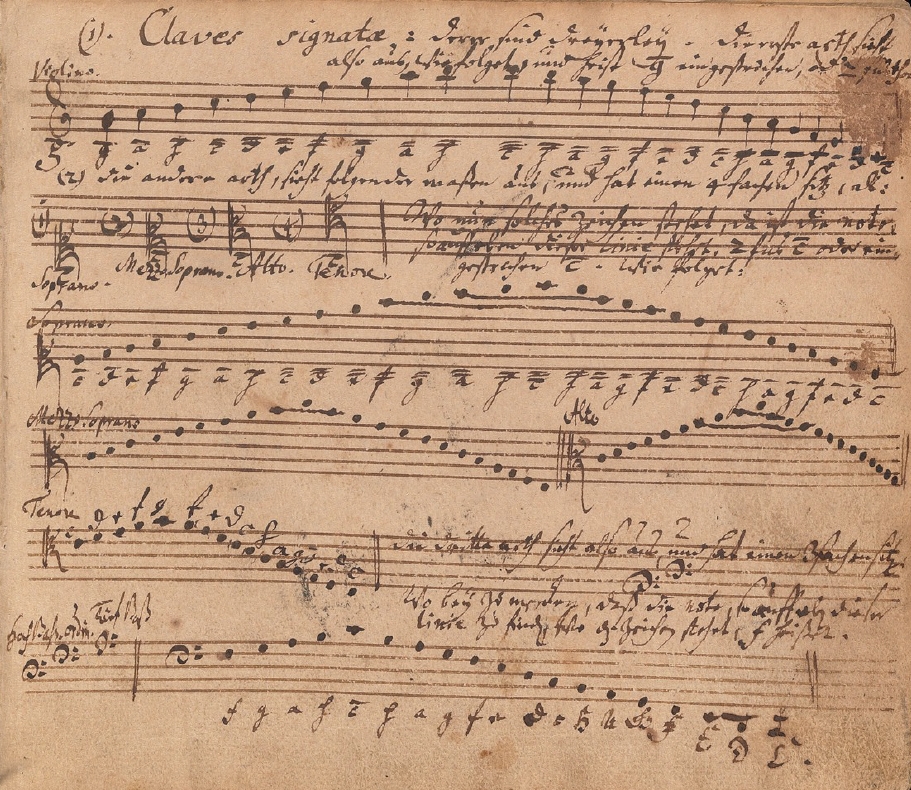
J.S. Bach’s clef guide, illustrating how different clefs are used to notate music for various instruments.
Introduction
What is Covered in Music Theory I?
The course starts with a comprehensive study of music fundamentals: pitch, rhythm, intervals, chords, diatonic harmony, roman numeral analysis, etc. Once these foundational concepts have been covered, more specific topics will be discussed: meter, syncopation, figured bass, embellishing tones, cadences, voice-leading, the phrase model, and composing in four-part harmony.
Curriculum Overview
CH 1
FundamentalsThe staff, clefs, grand staff, musical alphabet, ledger lines, whole/half steps, accidentals
CH 2
ScalesMajor scales, minor scales (natural, harmonic, melodic), scale degree names & numbers
CH 3
Key SignaturesKey concepts, key signatures, order of sharps and flats
CH 4
The Circle of FifthsCircle visualization, relative & parallel keys, key identification patterns
CH 5
IntervalsInterval size & quality, interval identification, interval inversion, compound intervals
CH 6
Rhythm & MeterDurations of sound & silence, time signatures, rhythmic values, the musical grid, beaming
CH 7
Compound & Asymmetrical MeterDotted rhythms, compound meters, asymmetrical meters, ties & beat preservation, tuplets
CH 8
Triads & Figured BassTriad structure & quality, triad inversions, figured bass notation & roman numerals
CH 9
Seventh ChordsSeventh chord structure, 5 standard qualities, inversions & figured bass symbols
CH 10
Part WritingFour-part SATB voicing, doubling rules, voice leading guidelines & chorale analysis
CH 11
Embellishing TonesPassing tones, neighbor tones, appoggiaturas, escape tones, suspensions, retardations, pedal points
CH 12
Tonic & Dominant FunctionHarmonic syntax, stability vs. tension, V–I motion, dominant seventh chords & resolutions
CH 13
CadencesAuthentic cadences (PAC & IAC), half cadences (HC), plagal cadences (PC), deceptive cadences (DC)
CH 14
The Pre-DominantPre-dominant harmonies, IV and ii chords, subdominant function & expanding harmonic syntax
CH 15
The Phrase ModelT–PD–D–T harmonic framework, phrase archetypes, melodic arches & harmonic trajectories
CH 16
Analysing MusicStep-by-step harmonic analysis workflow, Roman numeral analysis, lead-sheet symbols & structural hearing
CH 17
Six-Four ChordsPassing 6/4, pedal/neighboring 6/4, and arpeggiated 6/4 chord functions & voice leading
CH 18
Cadential Six-Four ChordsVoice-leading mechanics of the Cadential 6/4, metric placement, resolution to V, dominant embellishment
The Purpose of Music Theory
Theoretical knowledge about music has two purposes:
Musicians need to communicate with one another, especially during rehearsals. Without the technical language of music theory and notation, it would be difficult to describe a specific musical problem that needs to be fixed, or to orient oneself in a particular spot at the request of the director. But music theory is more than just the capacity to read music or communicate to other musicians through musical symbols, it is a means to significantly deepen one’s understanding of the musical material itself.
Music theory unlocks many of the secrets of music: why a particular harmony sounds unique, why a chord progression moves us emotionally, why a rhythmic passage physically excites us, etc. If we want to understand these mysteries, we need to analyze music from a theoretical perspective.
For those who wish to perform, theory is an indispensable guide to interpretation. How should one phrase this excerpt by Mozart? How should one interpret these dynamic markings in Beethoven? How should one approach teaching a choral anthem to a high school choir? These are important questions which every working musician will face on a daily basis. Music theory plays an essential role in this process of music making.
To write music, composers need to understand everything about the mechanics of notation and theoretical concepts. Even though composers don’t necessarily follow the traditional rules laid out in Theory I and Theory II, they must still be keenly aware of these rules and how they influence compositional decisions among the various styles of music throughout history.